 English
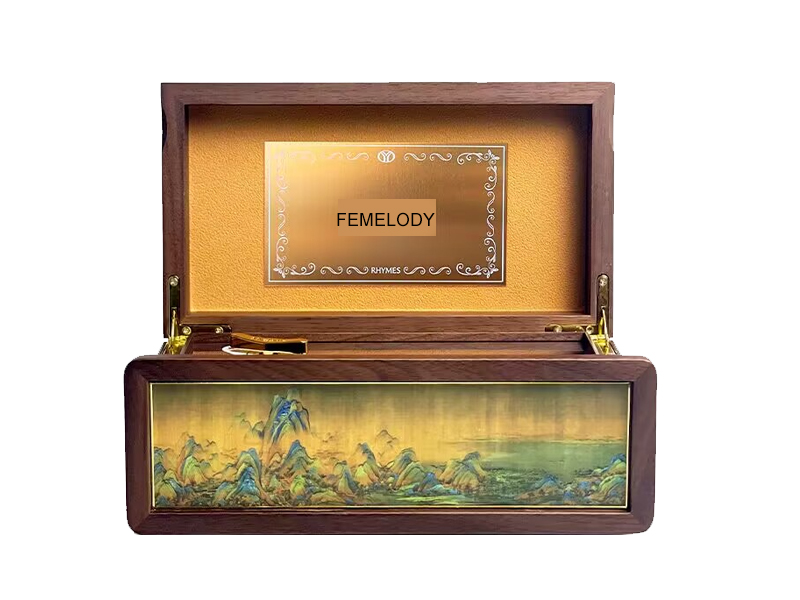
This collaborative product, featuring one of the ten of China's most famous paintings(A Panorama of Rivers and Mountains) and a high-quality walnut wood music box, is a high-end cultural and creative product that combines artistic collection with practical functionality.
✨ Core Design Highlights
Appearance Inspiration: The front of the box is decorated with the masterpiece "A Thousand Miles of Rivers and Mountains" by Wang Ximeng, a genius painter of the Northern Song Dynasty. The magnificent imagery of the verdant landscape complements the warm texture of the walnut wood, showcasing a strong sense of Eastern aesthetics.
Materials and Craftsmanship: The main body is crafted from black walnut wood, with a delicate texture and a sturdy structure. The interior is lined with velvet, protecting the movement and enhancing the overall quality.
🎵 Music and Movement
Brand Collaboration: FEMELODY focuses on the research and development of high-end music movements, ensuring clear and expressive sound quality.
Number of Notes: This series commonly features a 50-note version. The more notes, the richer the repertoire and the more delicate the tonal layers.
Piece Customization: Supports personalized music tracks, allowing you to engrave your own melody into the sound tube, making each music box a unique work of art.
🎁 Suitable Scenarios
Collection and Gifting: As a national trend cultural and creative product, it is an ideal choice for business gifts and cultural collection.
Home Decor: The Neo-Chinese style design blends seamlessly into spaces such as tea rooms and studies, enhancing the overall ambiance.
Souvenirs: Customized tracks can serve as commemorative gifts for important occasions such as birthdays and anniversaries.
A Panorama of Rivers and Mountains
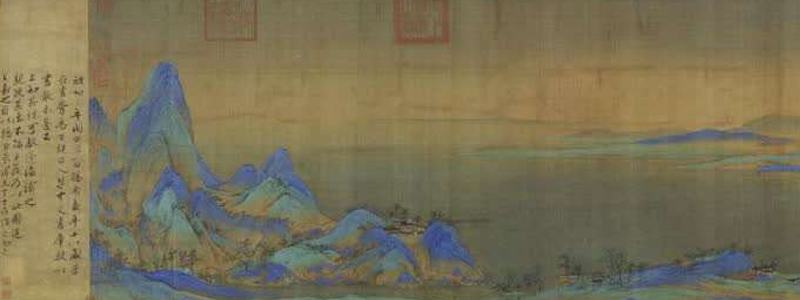
*A Panorama of Rivers and Mountains* is a long, colored silk scroll painting created by the Northern Song Dynasty prodigy painter Wang Ximeng at the age of 18. It is one of the ten most famous surviving paintings in Chinese history and a pinnacle of Song Dynasty blue-green landscape painting. It is currently housed in the Palace Museum in Beijing.
I. Core Information
Dimensions: 51.5 cm in height, 1191.5 cm in width, making it one of the longest landscape scrolls of the Song Dynasty.
Artist: Wang Ximeng, a court painter of the Northern Song Dynasty. According to Cai Jing's postscript, he was a student of painting and received personal instruction in brushwork from Emperor Huizong of Song. He completed this work in just six months, and it is his only surviving work.
Date of Creation: 1113 AD (the third year of the Zhenghe reign of the Northern Song Dynasty).
II. Artistic Features
Panoramic Composition: Employing the traditional scattered perspective of long scrolls, the painting is divided into six sections, connected by long bridges and flowing water, incorporating the techniques of high, deep, and level perspectives. The undulating peaks and vast rivers, arranged with a balanced density, create a rhythmic sense of ever-changing scenery, showcasing the vastness of a world within a small space.
The painting employs a rich, vibrant blue-green hue, primarily using mineral pigments such as azurite and malachite, supplemented with ochre as a base. First, ink lines are used for outlining and texturing, then layers of washes are applied, resulting in a deep, brilliant, and enduring color palette that combines decorative appeal with a three-dimensional effect. This style represents the pinnacle of blue-green landscape painting techniques.
The painting is meticulously detailed, depicting not only expansive landscapes but also intricate human elements such as fishing villages, farmhouses, pavilions, bridges, boats, and people engaged in fishing, traveling, and working. Although the figures are small, their movements are vivid, fully revealing the diverse aspects of life in Northern Song society and the ideal of a peaceful and prosperous nation.
III. Scenery and Connotation
* **Scenery Prototype:** The main scenery is based on the wetland landscapes of Lushan Mountain and Poyang Lake in Jiangxi Province, incorporating scenic spots from both the north and south, such as the waterfalls of Jiuli Lake in Fujian Province and the long bridge in Wujiang, Jiangsu Province, thus integrating regional characteristics.
* **Cultural Connotation:** It reflects Emperor Huizong's aesthetic pursuit of "abundance and prosperity," and also embodies the Northern Song literati's love for the beautiful landscape and their yearning for a stable life.
IV. **Provenance and Value:**
* **Provenance History:** This work was first bestowed upon Cai Jing by Emperor Huizong, then passed through the collections of the Southern Song imperial court, Pu Guang in the Yuan Dynasty, and Liang Qingbiao in the early Qing Dynasty. After entering the Qing Dynasty, it belonged to the imperial court, was once taken out of the palace by Puyi, and after the War of Resistance against Japan, it was scattered among the people before finally being transferred to the Palace Museum by the State Administration of Cultural Heritage.
* **Artistic Value:** The Yuan Dynasty calligrapher Pu Guang praised it as "unparalleled for a thousand years, almost like a solitary moon among stars." It not only inherited the tradition of blue-green landscape painting from the Sui and Tang dynasties, but also broke through limitations with the brushstrokes of a young painter, becoming an insurmountable milestone in the history of Chinese landscape painting, and is known as one of the "Two Masterpieces of the Northern Song Dynasty" along with "Along the River During the Qingming Festival".
Don't forget, you can sharing on social media!



 Deutsch
 Spainish
 French
 Italian